For years, the equipment known as the Diablo Screening Washer has established itself as an effective solution in wastewater treatment plants for the treatment of waste from screening rakes.
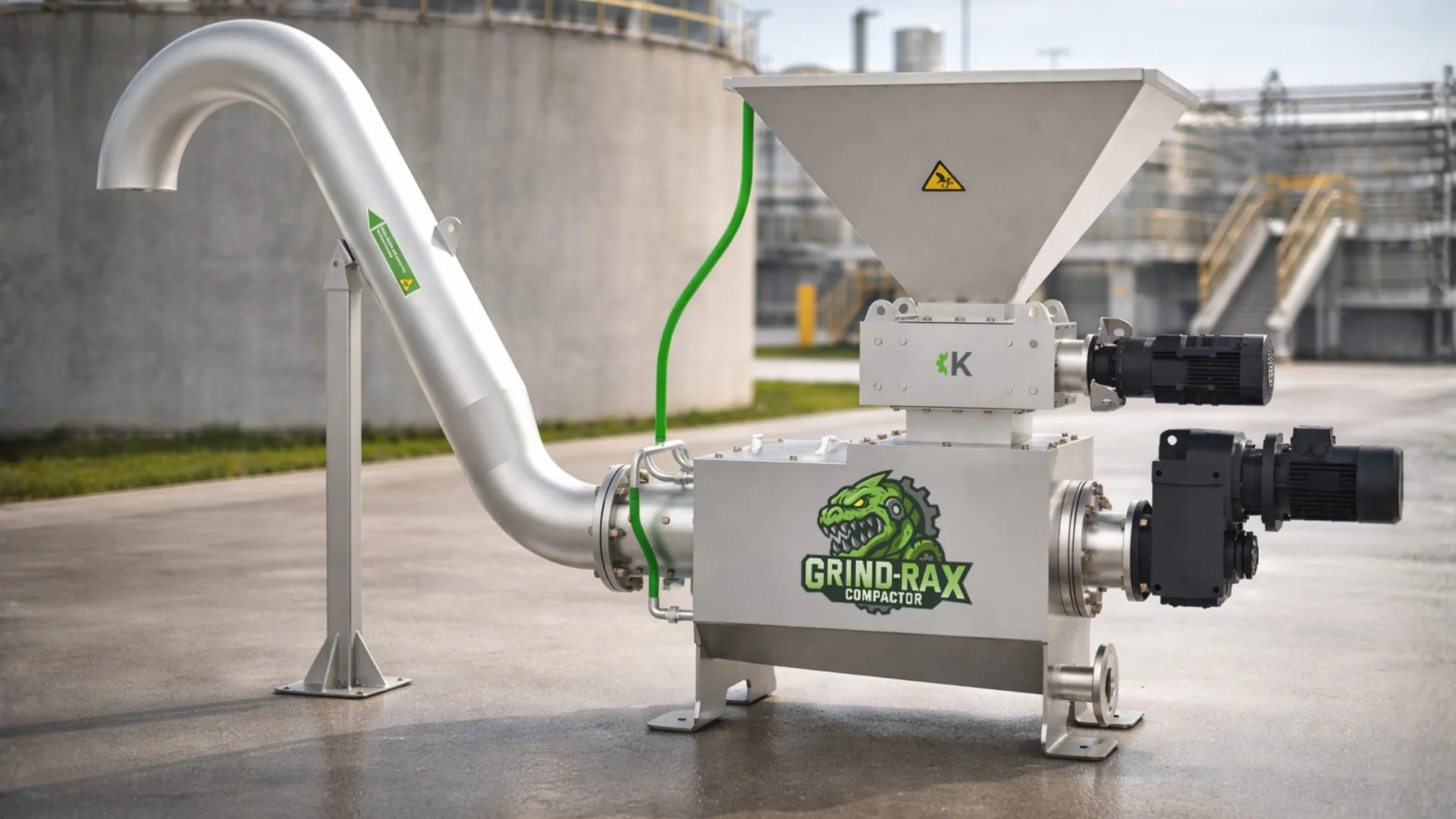
Today, this equipment is evolving and is now called the GRIND-RAX Compactor, maintaining its original concept but strengthening its positioning as an integral solution for waste shredding, washing, and compaction.
This change does not imply a modification of its functionality, but rather an evolution in the range and its integration within broader solids treatment solutions.
What is the GRIND-RAX Compactor and what is it used for?
The GRIND-RAX Compactor is a compact waste management unit designed to treat solid waste collected from screens in wastewater treatment plants (WWTP).
Its main function is clear: to transform voluminous, wet waste with high organic content into a cleaner, drier, and easier-to-manage solid.
To achieve this, the unit integrates the following into a single system:
- Shredding
- Washing
- Solid-liquid separation
- Compaction and dewatering
This approach allows waste to be treated directly on-site, reducing problems associated with transport, odors, and landfill management.
How it works in a WWTP: A continuous process
One of the keys to the GRIND-RAX Compactor is that it does not act as an isolated piece of equipment, but as part of the pretreatment process.
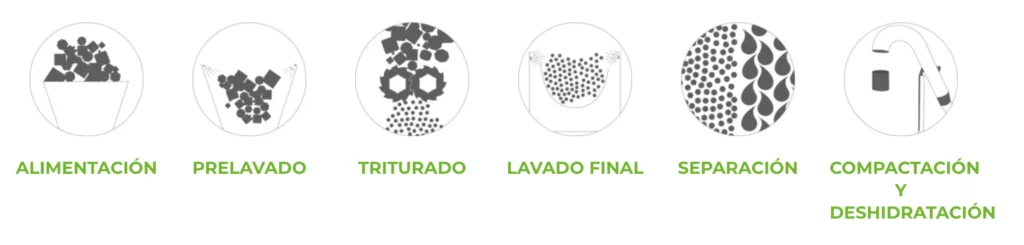
Its operation is based on a continuous 6-stage cycle:
- Waste is fed into the inlet hopper.
- An initial wash is performed to remove part of the organic matter.
- The shredding system reduces the size of the solids.
- A second wash improves the cleanliness of the waste.
- The liquid fraction is separated from the solid.
- The waste is compacted and dewatered before discharge.
This double washing allows organic matter to be returned to the purification process instead of being sent to a landfill, improving the overall efficiency of the facility.
Problems solved on-site
In many treatment plants, waste generates constant operational issues:
- High volume of waste
- High organic matter content
- Odors
- Transport and management costs
The GRIND-RAX Compactor unit acts directly on these points.
On one hand, it reduces waste volume by up to 90%, which directly impacts logistics costs.
On the other hand, it achieves dewatering of 45–55%, generating a drier and more manageable solid.
Furthermore, by removing a large portion of the organic matter, it achieves a significant reduction in odors and a cleaner discharge.
Operational advantages of the GRIND-RAX Compactor
Beyond its function, the value of the GRIND-RAX Compactor lies in its direct impact on the plant’s daily operations.
As a compact system, it can be easily installed even in limited spaces. Additionally, it allows for continuous processing of the generated waste, avoiding accumulation and manual handling.
Another relevant aspect is that the equipment can be supplied as a rental solution or for testing, facilitating its validation on-site before a final investment.
From Diablo Screening Washer to GRIND-RAX Compactor
The transition from Diablo Screening Washer to GRIND-RAX Compactor reflects an evolution in how the equipment is presented and positioned within waste treatment in purification.
While the previous name referred to a type of equipment widely recognized in the sector (screening washer), the new brand focuses on its main function within the process: integrated shredding, washing, and compacting of waste.
The term GRIND-RAX Compactor reinforces this idea, conveying more directly what the equipment does and where it adds value. In this sense, the evolution is not just in name, but in focus: a more clearly defined solution, aligned with the current needs of plants and with a more coherent identity within the Protech Continental Group range.
GRIND-RAX Compactor (formerly Diablo Screening Washer) is a consolidated solution for the treatment of screening waste in wastewater stations.
Its ability to integrate shredding, washing, and compaction into a single unit allows for volume reduction, removal of organic matter, and improved waste management on-site.
In a context where operational efficiency and cost reduction are increasingly important, these types of solutions play a key role within pretreatment.